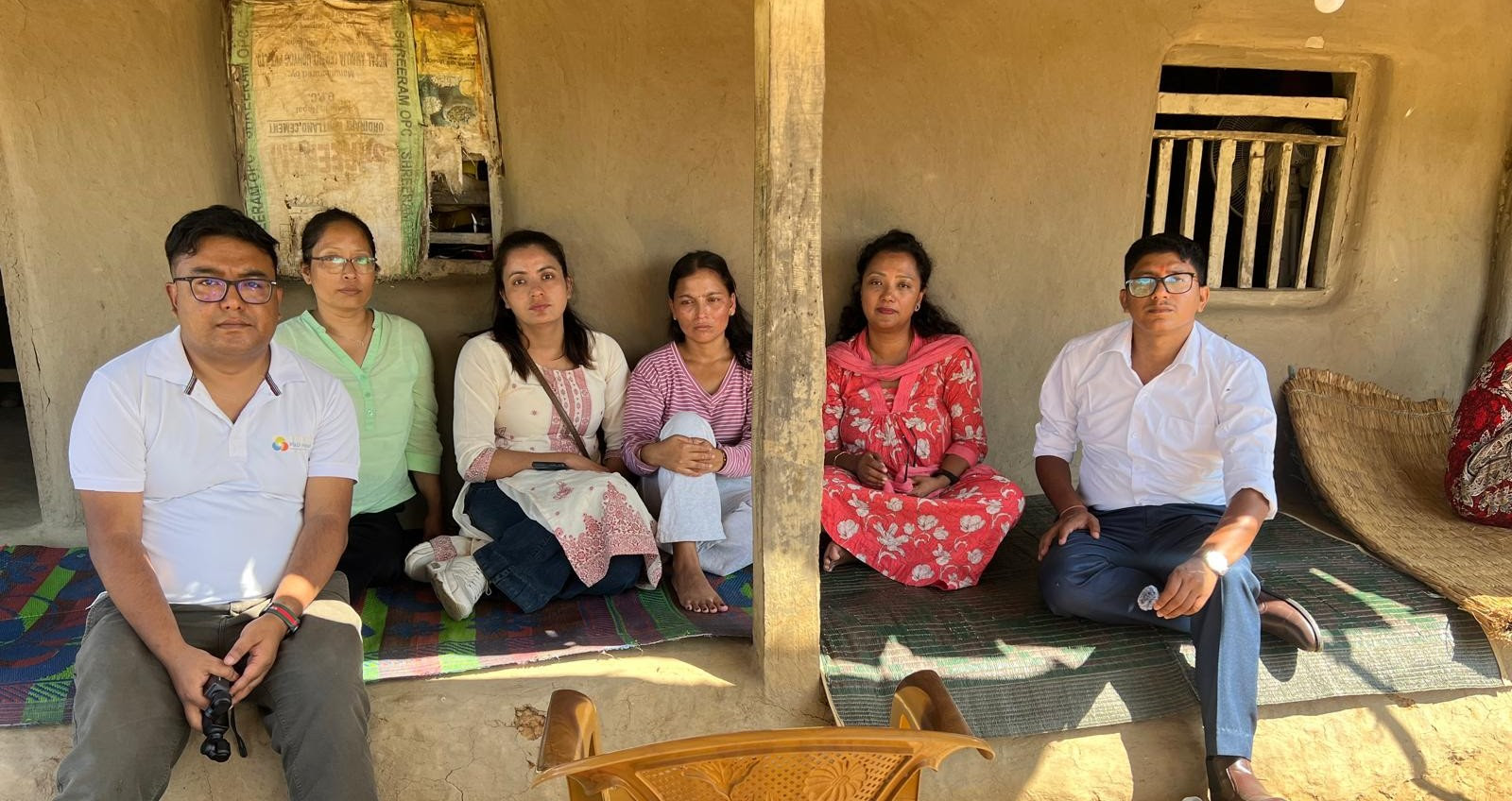
Earlier this month, READ Global Executive Director Sanjana Shrestha visited communities in Nepal affected by the devastating August floods. She met with families who lost loved ones, local leaders, and READ Center volunteers who stepped forward to support their communities.
In the first of two reflections from her visit, Sanjana shares what she witnessed in Nawalpur, where the floodwaters carried tragedy far downstream, and how years of community relationships helped make a difference in the response.
Next week, we’ll share her reflections from Nuwakot, closer to the source of the flooding, where communities experienced devastating destruction firsthand.
Fifty-two Days After the Flood: What the Water Carried, and What It Left Behind
By Sanjana Shrestha, READ Global Executive Director
On October 10, fifty-two days after the devastating flood, my team and I were back in Nawalpur, this time to understand what had helped communities respond, and what recovery was beginning to look like.
What stayed with me was not only the scale of loss, but the way people stepped forward for one another. At the heart of that response was Agyauli READ Center, drawing on relationships built over years to mobilize volunteers and organizations, connect families with support, and stand alongside them during this extraordinarily difficult time.
This is a story not only of disaster, but of community, trust, and what becomes possible when relationships are already in place before a crisis begins.
When the disaster travelled downstream
The flood began far to the north, in Rasuwa. Huge waves of muddy water rushed downstream, carrying debris, livestock, and human remains. What began in the mountains eventually reached communities much farther south along the Narayani River in Nawalpur.
When bodies began appearing in the river near their communities, representatives of the local READ Centers did not stop to ask whether responding was formally their responsibility.
They simply began to help.
Bodies recovered from the river were taken to Madhyabindu Hospital, about seven kilometres from the Narayani River. Soon, families from across Nepal began arriving there, searching for missing sons, husbands, brothers, daughters, and other relatives. Many came carrying photographs of the people they hoped to find.
The hospital filled with people carrying exhaustion, fear, and shock. Some sat or lay on the bare floor for hours, holding photographs tightly in their hands. Many had travelled long distances, even from Gorakhpur, India and did not know where they would sleep that night.
Some were too overwhelmed even to eat or drink. Center representatives remembered family members saying, “Why should I eat? Why should I drink? The person I came for is gone.”
The Center representatives stayed beside them. They brought food, water, and oral rehydration salts, helped families find places to rest, supported them through hospital and administrative processes, and sometimes simply sat with them until they were ready to take a sip of water or a few bites of food.
When they noticed families sleeping on the floor outside the hospital, the Center quickly contacted the local Hotel Entrepreneurs’ Association. Free accommodation was arranged for around 80 families.
The Center President, Shiva, also remembered going to local shops to buy food and other essentials. Once shopkeepers understood who the supplies were for, some quietly added extra rice, lentils, biscuits, noodles, spices, water, and other items without charging.
“You are helping the families. Let us also contribute.”
In that way, the response became larger than the Center itself. People across the community began offering whatever they could.

Agyauli READ Center volunteers assemble a temporary station for victim identification
A hospital that had no time to prepare
The hospital had never expected to deal with a situation of this scale.
Doctors, nurses, police, and other workers suddenly found themselves handling bodies and body parts, often without enough protective equipment. The READ Center purchased gloves, masks, and sanitizers so they could work more safely.
There was also not enough space at the hospital to store the bodies. Center representatives quickly coordinated with the local Community Forestry Office, which opened its yoga hall for temporary storage.
As bodies and dead livestock accumulated, the smell became overwhelming. The Center purchased disinfectants and incense sticks and helped clean the surrounding area, trying to make an unbearable environment a little more manageable for grieving families, hospital staff, police, and volunteers.
More than 43 volunteers were mobilized, including former Center presidents, library members, staff, and participants from Tech Age Girls (TAG), a READ Center leadership program for young women. For around fourteen days, they worked from early morning until late at night, helping wherever they were needed.
A doctor told us that managing the situation without the Center would have been extremely difficult. He was struck by how quickly local people and resources had been mobilized.
A police officer told us something similar: “Our work became easier because of the Center. They stood with us and worked alongside us. It was a difficult time for us too, but the Center helped share the burden.”
Journalist Dayaram Acharya reflected on what he had witnessed: “Seeing a community library step forward during a crisis changed my understanding of what a library can be. It can be a trusted place that brings people together, mobilizes support, and stands with the community when it is needed most.”
Gloves, masks, disinfectant, food, water, volunteers, somewhere to sleep. None of these things sound extraordinary on their own, but in those days they were exactly what people needed.
The photograph carried from Bajura
One story I heard during my visit has stayed with me.
A woman had travelled all the way from Bajura in far western Nepal, carrying a photograph of a missing young man.
The photograph looked old and worn, as though it had been held many times. I found myself wondering whether it was the same photograph his mother kept close while he was away for work, a small way of keeping him near when he was far from home.
His mother had not been able to make the journey herself. She was unwell, the family could not afford the travel costs, and the missing young man was their only breadwinner.
So, a neighbour travelled in her place, carrying his photograph across the country and hoping someone at the hospital might recognize him.
They never found his body.
His mother does not have a phone, so the Center has not been able to speak with her directly. Instead, they have remained in contact with the neighbour who came searching for the family.
That image stayed with me, a worn photograph travelling hundreds of kilometres because a mother could not make the journey herself. It reminded me that disasters do not affect every family equally. For some, searching for a missing loved one means arranging transport and accommodation. For others, even getting to the place where they might find answers is beyond what they can afford.
And sometimes, after travelling all that way, there are still no answers.
When grief meets bureaucracy
Even finding a loved one did not necessarily mean the ordeal was over.
Families then had to go through formal procedures before a body could be released. Some had limited literacy, and the paperwork was difficult to understand at a time when they were already exhausted and grieving.
Imagine finally identifying the person you had been searching for, only to be told that you now had to travel somewhere else to complete documents.
The READ Center raised this concern with the authorities and asked whether the process could be handled directly at the hospital. The request was accepted. When computer equipment needed for the documentation stopped working, Center representatives also helped get it functioning again.
It reminded me that suffering in a disaster does not come only from the disaster itself. Sometimes it also comes from systems that are difficult to navigate when people are at their most vulnerable.
Sometimes helping is simply removing one more burden from someone who is already carrying too much. Sadly, as the identification process became more complex, regulations became stricter and DNA testing was required. But the necessary testing equipment was not available locally. This meant that even when community members believed they had identified a body, families were sometimes unable to take their loved one home.
| For fourteen days, the Center maintained a help desk at the hospital. During that time, it supported more than 400 families, some from nearby communities and others who had travelled from across Nepal. Even now, the Center continues to receive calls from families asking for help. And the support did not stop when people left the hospital. The Center has continued trying to stay in touch with families wherever possible, to understand what they may still need and whether further support can be provided. That is how our visit took us from the hospital into the villages. |  |
In the villages, the loss became personal
We travelled to Setapani and Bagkhor.
Twenty-one young people from the district had gone to Rasuwa to work as daily wage labourers. All twenty-one were killed in the flood, including eight from these two villages. The Center has remained in regular contact with the affected families, providing financial support to help with funeral and remembrance rituals, as well as essential materials based on what each family needed.
These young men had left home for one reason: to earn money for their families. Many were husbands and fathers. Their wages paid for food, schooling, household expenses, and support for older parents.
Fifty-two days later, their absence could still be felt everywhere.
The day we arrived was the dark moon day, Pitri Tithi, when Tharu families were observing a final ritual for loved ones who had died. The timing made the grief feel especially close.
| The houses were simple. Many were made of mud, with a single room shared by several family members; others were small wooden huts. At one home, we met a 27-year-old widow with a four-year-old son. Her husband’s body had never been recovered. The family had performed a symbolic cremation. | 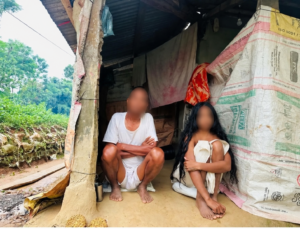 |
Her little boy had not yet been told that his father had died. Every evening, he asks to speak to him. His mother tells him that his father is busy and cannot talk today.
Her husband had been due to return home in only six or seven days. Instead, he never came back.
She spoke quietly about what would happen now. She works on a small farm and did not know how she would support her family.
In another village, we sat for more than an hour with another family.
The elderly mother had already lost her older son two years earlier. Now her younger son was gone too.
His wife had never seen his body, and part of her still believed that her Kanchu, the pet name she used for him, might somehow return.
Kanchu had already been through difficult times. He had taken a loan to go abroad for work but was scammed and lost the money. After that experience, he decided he wanted to remain in Nepal, close to his family, and rebuild his life at home.
He went to Rasuwa to work so he could support his family and give his son a good education. Although their income was modest, they had enrolled their son in a local private school. Much of what Kanchu earned went toward his education.
When we asked what she needed most, she could not really answer. How could she? Fifty-two days later, she was still trying to understand a life that had changed in an instant.
But there was one thing she mentioned again and again. She wanted to visit the place where her husband had worked. She wanted to see the river that had taken him.
Toward the end of our conversation, I quietly asked his wife about her own dreams.
She told me she had wanted to learn tailoring. Perhaps one day, she said, she might have opened a small shop selling beauty and personal items. Her husband had asked her to wait a few years while he tried to earn more.
Then she said quietly, “I know he will come to take me with him.”
I gently asked, “And what about your son?”
She became silent.
There are moments during field visits when there is nothing useful to say.
So we simply sat with her.
After some time, she told us something I have not forgotten. People come and go, she said, but very few stay long enough to listen to their pain. She said that after talking with us, she felt a little lighter.
That moment stayed with me.
Recovery is not only about food, cash, shelter, or replacing what was lost. Those things matter enormously. But sometimes people are not yet ready to tell us what they need.
Sometimes they first need time. They need space. And they need someone willing to stay long enough to listen. Sometimes recovery begins there.
One lesson I am carrying from these visits is that people affected by disaster may not always be able to tell us what they need. In the middle of grief, shock, and uncertainty, even the question “What do you need?” can be difficult to answer.
As development practitioners, our responsibility is not only to ask questions, but to pay attention. To notice silence. To notice what people repeat. To notice who is missing from the conversation, who is struggling to navigate systems, who keeps returning to the same worry, and who may need more time before they can speak about what comes next.
Most needs after a disaster are visible and practical: food, water, shelter, income, documents. But some are less visible, like being heard, being accompanied, or simply having someone return after others have left.
| The READ Method asks us not to arrive only with solutions, but with presence, curiosity, and patience. By staying close to families over time, we can better understand how their needs change, including the needs they may not yet be able to put into words. Nawalpur also showed what this means in practice. The local Center responded quickly because it was already trusted and connected within the community. READ’s role was to stay alongside the Center, understand what was emerging, help mobilize additional resources, and step in where local capacity alone was not enough. |  |
In the months ahead, READ will continue working through local Centers to stay close to affected families, understand how their needs are changing, restore livelihoods, protect children’s education, connect families to services and entitlements, and strengthen communities to prepare for future disasters. Support for this next phase will help us move beyond immediate relief and walk alongside families as they rebuild their lives.